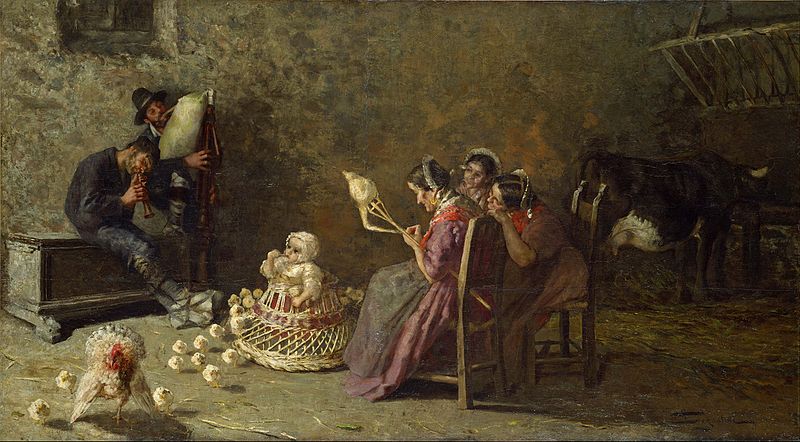
Giovanni Segantini, Bagpipers of Brianza c.1883, oil on canvas, National Museum of Western Art, Tokyo. Public Domain Image from Wikimedia Commons.
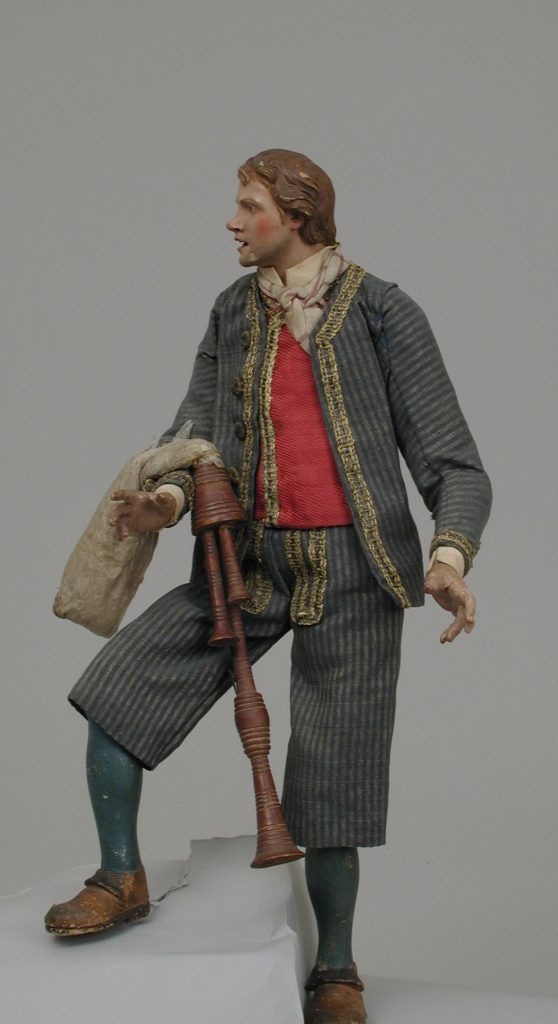
The zampogna, according to the Metropolitan Museum, “is a bagpipe found in mountainous regions across Central and Southern Italy, including Sicily… the name ‘zampogna’ most likely derives from the Latin ‘symphonia’ and became a standard name for the bagpipes in Italy from the 15th century onward.” The instrument is traditionally associated with shepherds and during the festive season in Italy, zampognari, accompanied by a fellow musicians playing the ciaramella or piffaro can be seen in devotional processions and at Christmas celebrations.
Young Man in Suit with Bagpipes, late 18th–early 19th century Neapolitan, polychromed terracotta head; wooden limbs and bagpipes; body of wire wrapped in tow; garments of various fabrics, Metropolitan Museum, New York. Gift of Loretta Hines Howard, 1978. Public Domain Image.
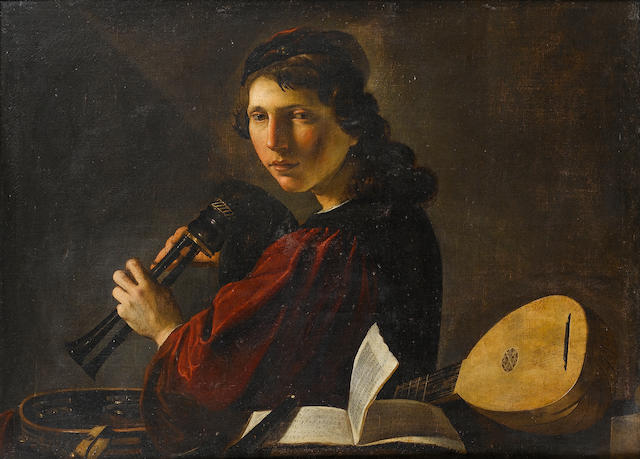
Agnolo Bronzino, Adoration of the Shepherds (detail), 1539-40, oil on poplar wood, Museum of Fine Arts, Budapest. Public Domain Image from Wikimedia Commons.