
Bulletin Board
The IAS bulletin board allows members to communicate directly with each other on topics of common interest, including placing or responding to classified ads (housing, employment, child care, etc.), requesting or sharing travel tips, or connecting with other members in Italy or elsewhere. (See also Opportunities & Continuing Education. ) Nothing on the bulletin board should be taken to constitute professional advice or a formal recommendation. Disclaimer.
Post a bulletin (member login required). Please send bulletin board comments or questions to the Webmaster.
October 15, 2026
Fall 2026 Newsletter
August 17, 2026
Research Workshop: Sacred Sensoria: Jewish and Christian Embodied Experience in Early Modern Europe
Sacred Sensoria: Jewish and Christian Embodied Experience in Early Modern Europe
A Research Workshop of the Israel Science Foundation
25-28 October 2026
Israel Institute for Advanced Studies, Edmond J. Safra Campus, Givat Ram, The Hebrew University of Jerusalem (Monday and Wednesday), and Prima Park Hotel, Jerusalem (Tuesday)
Early modern Europeans saw, heard, touched, tasted and smelled their way into the sacred. Preaching, devotion, mystical practice and confessional polemic alike were conducted in the grammar of sensation, and the boundary between Jew and Christian was often drawn by disputing whose senses could be trusted.
Sacred Sensoria gathers historians, literary scholars, art historians and historians of religion from Europe, North America and Israel in order to study the two sensory regimes together rather than apart, across three days: Frameworks, Contact Zones, and Comparative Senses.
Keynote lectures: Prof. Bruce Gordon (Yale University), Prof. Magda Teter (Fordham University), and Prof. Stefan Michels (Goethe-Universitaet Frankfurt).
Convened by Dr Yaakov A. Mascetti (Bar-Ilan University) with Dr Channah Damatov (Bar-Ilan University).
Attendance is free and open to all; no registration is required.
Full programme and details:
https://www.google.com/url?q=https://iias.huji.ac.il/event/sacred-sensoria-jewish-and-christian-embodied-experience-early-modern-europe&source=gmail&ust=1786959320343000&sa=E
July 20, 2026
CFP: “Medieval Italian Women & Visual Culture (5th-14th cents)”(CAA 2027)
CFP for CAA New York, Feb 3-6, 2027: Medieval Italian Women & Visual Culture
This session investigates how medieval Italian women lived their lives both in compliance with and in circumvention of the societal assumptions circulating about their nature and capabilities, read through their relationships to visual images and artistic patronage. Papers will address this topic through two lenses: 1) ways that gendered religious and social beliefs were encoded in visual imagery and 2) how women of different social and economic strata negotiated regulations that defined and constrained them in the ways they engaged with visual imagery or commissioned works of art or architecture.
The roles of women as artists, patrons, and audiences for illuminated manuscripts enjoy extensive in-depth study for northern medieval cultures since the mid 20th century. Studies of women’s participation in the visual culture of medieval Italy are much rarer and less well-known. This session seeks to help redress that imbalance by focusing on medieval Italian women as patrons, but also as audiences of artistic projects and performative visual media, and the ways women responded to or helped shape the imagery and ideas those works projected.
Papers are welcome from art history scholars in all stages of their careers as well as advanced graduate students whose research focuses on Italy in the 5th through 14th centuries.
To submit a proposal, please go to CAA 2027 Program
Submission deadline: Aug. 31; Notifications will be sent out on September 16
CAA Proposal ID: 18242
July 20, 2026
Doctoral Positions in Methods and Methodologies of Archaeological and Art-Historical research at the University of Salerno
Doctoral Positions in Methods and Methodologies of Archaeological and Art-Historical research
The scholarships are posted here: https://euraxess.ec.europa.eu/jobs/452942
The University of Salerno announces the establishment of the XLII Cycle of the PhD courses.
The public competition for admission to the PHD Programme in Methods and Methodologies of Archaeological and Art Historical Research–MEM (website: https://www.dottoratomem.it/), at the Department of Cultural Heritage Sciences–DiSPaC, is currently open. The closing date for applications is 06.08.2026.
The MEM doctoral degree has three curricula:
A) ARCHAEOLOGY AND TERRITORIAL SYSTEMS
B) HISTORY OF ART, AESTHETICS, and LANGUAGES OF IMAGES
C) MUSICOLOGY AND PERFORMING ARTS
The participation in the public competition is reserved to applicants who hold higher-education qualifications, or have obtained an equivalent qualification abroad, without any restriction of age and citizenship.
For particulars about the qualifications and the application procedures, please look at the call: https://web.unisa.it/uploads/rescue/277/14639/call-for-phd-courses-xlii-cycle.pdf; the specifics for the MEM doctoral school can be found here: https://web.unisa.it/uploads/rescue/151/9743/methods-and-methodology-in-the-archaeological-and-art-historical-research-2026.pdf
July 10, 2026
Sculpture Journal Essay Prize
Sculpture Journal Essay Prize
We are pleased to announce the inaugural Sculpture Journal Essay Prize to coincide with the journal’s thirtieth anniversary year in 2027. The editors invite research articles on any topic relevant to Sculpture Journal’s readership from early career researchers and doctoral students. These should be between 6,000 and 9,000 words (including notes) in length with a maximum of 10 images. The editors will review all submissions to select the prize winner and will work with the successful candidate to prepare the manuscript for publication after peer review. Other promising articles submitted to the prize may be invited to publish their submission in Sculpture Journal.
The deadline for submissions of full articles is 15 January 2027; email submissions to both Teresa Kittler (teresa.kittler@york.ac.uk) and Natasha Ruiz-Gómez (natashar@essex.ac.uk) with the subject line ‘Sculpture Journal Essay Prize’. Please refer to our style guidelines before submitting:https://www.liverpooluniversitypress.co.uk/journal/sj.
The prize includes:
- Publication of the winning essay (scheduled in Sculpture Journal’s thirtieth anniversary year in 2027)
- Image permission costs covered up to an agreed amount
- Free Open Access for the article
- Featured promotion across Liverpool University Press platforms
- A complimentary one-year subscription to the journal
In the unlikely event that, in the editors’ opinion, the material submitted is not of a suitable standard, no prize will be awarded.
July 3, 2026
CFP: Late Medieval and Early Renaissance Italian Women & Visual Culture (RSA 2027)
This session investigates how medieval Italian women lived their lives both in compliance with and in circumvention of the societal assumptions circulating about their nature and capabilities, read through their relationships to visual images and performative media. Papers will address this topic through two lenses: 1) ways that gendered religious and social beliefs were encoded in late medieval-early Renaissance visual imagery and performance and 2) how women of different social and economic strata negotiated regulations that defined and constrained them in the ways they engaged with these media.
The roles of women as artists, patrons, and audiences for visual culture enjoy extensive in-depth study for northern medieval and Renaissance cultures since the mid 20th century. Studies of women’s participation in the visual culture of late medieval/Early Renaissance Italy, itself an often-marginalized field, are much rarer. This session seeks to help redress that imbalance by focusing on late medieval-early Renaissance Italian women as patrons, but also as audiences of artistic projects and performative visual media, and the ways women responded to or helped shape the imagery and ideas those works projected.
Papers are welcome from scholars in all stages of their careers whose research focuses on Italian images of and/or used by women, ideas about women constructed or reflected in religious drama, or sermon literature that address women or ideas about women in the 14th-early 15th centuries.
If you are interested, please send an abstract for a 20-minute paper (max 300 words) and a short c.v. by JULY 10 to jsteinhoff@uh.edu
The session configuration will be announced on or before August 4.
June 23, 2026
The Medieval Southern Italy Working Group
The Medieval Southern Italy Working Group
The Center for the Art and Architectural History of Port Cities “La Capraia” is delighted to announce that with Maria Harvey, we have launched the Medieval Southern Italy Working Group, dedicated to fostering exchange and collaboration among art historians of medieval southern Italy and those curious about venturing south.
We plan on workshopping talks, syllabi, publications, thesis chapters, and other academic endeavors, in Italian or in English, and to meet two or three times a semester online and once a year in person in Naples.
We would be very glad to hear from art historians (including graduate students), curators, and conservators interested in joining this working group. Please send name, e-mail, and institutional affiliation (if applicable), and brief details of particular areas of interest to harveymx@jmu.edu
Please feel free to share this news with anyone who may be interested.
Website: https://arthistory.utdallas.edu/port-cities/projects/medieval-southern-italy-working-group/
June 23, 2026
CFP: Venice and its Mainland Empire (at RSA 2027)
CFP: Venice and its Mainland Empire (at RSA 2027)
While the Venetian Republic was creating a stato da mar in the Mediterranean to ensure its economic security and military defense, it was also expanding its territories in the Terraferma — the Veneto and the Friuli — with its political authority framed as a mutually beneficial system of reciprocity and abundance. In 1483, the Venetian diarist Marin Sanudo described a fresco on the public loggia in the Veneto town of Rovereto that featured the lion of St Mark and an inscription: “I am the lion, of whom no one possesses a broader world empire; the land and sea obey me, and I administer justice: and beware to those men who do evil, my sword will avenge their crimes.”
In recent years Save Venice has expanded its conservation efforts into the Terraferma with such masterpieces as Titian’s Annunciation in Treviso and Donatello’s equestrian monument to Gattamelata in Padua. This session, sponsored by Save Venice, invites papers exploring the political, cultural and artistic reach of Venice in its Terraferma territories from the fourteenth through the seventeenth century. Possible topics include civic infrastructure, public monuments and paintings; portraits; commissions by Venetian officials; villa life, and male and female Terraferma artists in Venice and Venetian artists in the Terraferma.
Prospective speakers should send their full name, current affiliation, and email address, along with their paper title (15 words maximum), abstract (200 word maximum), and resume (2 pages maximum), PhD or other terminal degree completion year (past or expected) to Sarah Blake McHam (sarah.blake.mcham@gmail.com) and Patricia Fortini Brown (pbrown@Princeton.edu) by July 15. Applicants will be notified by July 31.
For more information, click here: https://www.rsa.org/page/RSAAnnualMeetingCFPIndex
June 23, 2026
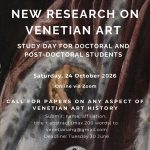
New Research on Venetian Art — A Study Day for Doctoral and Post-Doctoral Researchers
The Venetian Art History Research Group (VAHRG) invites submissions for its second virtual conference, open to current PhD students and postdoctoral researchers working on any aspect of Venetian art history.
The conference will take place online via Zoom on Saturday, 24 October 2026, and will be hosted by members of the VAHRG committee.
We welcome proposals for short papers presenting current research on Venetian art. Presentations may be given in either English or Italian, be accompanied by a PowerPoint, and not exceed 20 minutes.
Those interested in participating are invited to submit a proposal title and an abstract (maximum 200 words) to venetianahg@gmail.com by Tuesday, 30 June 2026. Please also include your current university affiliation and the contact details of your supervisor(s).
December 1, 2020
Member Bulletins
Communicate with other members on topics of common interest by posting on the bulletin board! Please use this form.