
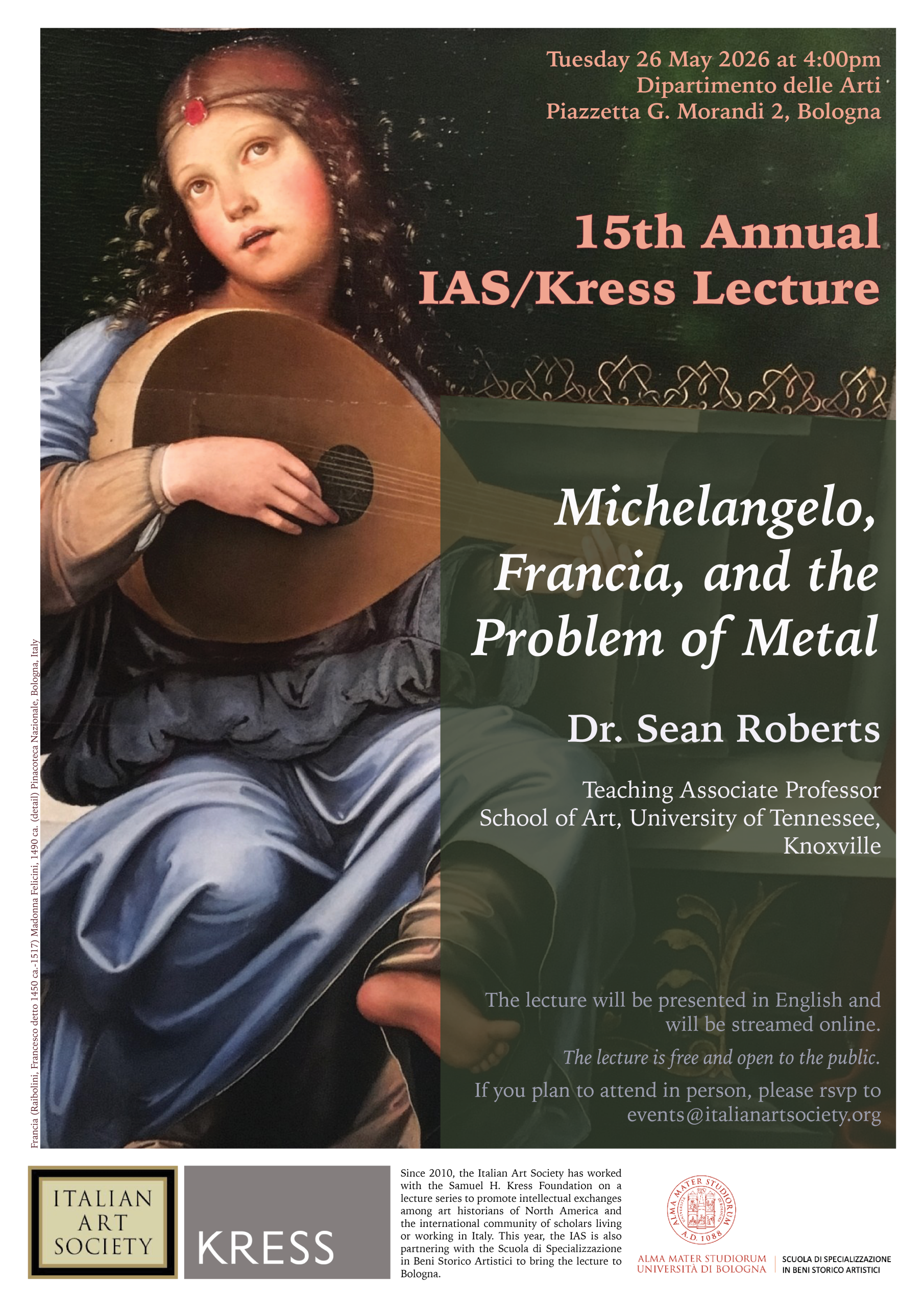
This was the 15th Annual IAS/Kress Lecture
Dr. Roberts is a former IAS President and currently, Teaching Associate Professor in the School of Art at the University of Tennessee, Knoxville. Having extensively published early modern Italy and the Mediterranean, his current research looking at one of Bologna’s most important Renaissance masters Francesco Raibolini, known as “Francia.” It is this current research in which he will present at the IAS/Kress Lecture.
This year, the IAS is also partnering with the Scuola di Specializzazione in Beni Storico Artistici to bring the 15th annual lecture to Bologna.
You can watch the recording of the lecture on our YouTube Channel here.
2026 IAS/Kress Lecture – Tuesday 26 May 2026 at 4pm CEST (10 am EST)
Location: Dipartimento delle Arti, Università di Bologna, Piazzetta G. Morandi 2, Bologna
Speaker: Dr. Sean Roberts, Teaching Associate Professor, School of Art, University of Tennessee, Knoxville
Lecture Title: Francia, Michelangelo, and the Problem of Metal
Abstract: In his Vite Giorgio Vasari relates an encounter between his perennial hero Michelangelo and the Bolognese goldsmith and painter Francesco Raibolini, known as “Francia.” Michelangelo was working on the now destroyed statue of his great benefactor Pope Julius II for the portal of San Patronio. Francia came to look for himself at the Florentine’s sculpture having “heard much of his fame and works, but never having seen any of them.”
On being asked what he thought, he replied that it was a fine casting from beautiful metal. But hearing this, Michelangelo supposed that he was praising the bronze rather than the artist, and remarked to Francia: ‘I am indebted to pope Julius, who gave it to me, as you are to the shopkeepers who supply you with your paint.’ He continued angrily, in the hearing of all the men gathered around, that Francia was an idiot.
Michelangelo’s probably apocryphal insult follows a clear pattern for the Lives, driven by Vasari’s sense of local Tuscan pride. Francia is accused of being a provincial Bolognese rube who commits the cardinal sin of valuing base materials over their transformation through disegno; of valuing gold over skill. The paradigm of Leon Battista Alberti’s – and later Michael Baxandall’s – conceptions of artistic evolution are thus assailed.
In fact, over the course of a forty-year career, Francia oversaw Bologna’s preeminent goldsmith’s shop, supervised the city’s mint, and established himself as among the most sought-out painters of Italy. Vasari himself knew this. His own life of Francia presents a laudatory portrait that departs sharply from the role in which he cast the artist within the life of Michelangelo. Despite this place in the visual and material fabric of one of the peninsula’s most vibrant cultural centers, however, Francia’s position in both the scholarly tradition and popular conception outside of Emilia lags far behind his Roman, Milanese, and Florentine contemporaries.
This lecture seeks to restore a sense of the historical centrality of this pivotal artist and, more importantly, of works in metal at the start of the century. I shed light on the reasons for this nearly five-century process of marginalization and focus on several core issues raised by Francia’s location within changing conceptions of Renaissance media and their motivations. I consider the longstanding and misplaced characterization of early sixteenth-century Bologna as peripheral to central artistic hubs, especially Florence and Rome. I examine Francia’s liminal status within Italian art history on account of his supposed “foreignness.” The artist took his nickname from his teacher, an unidentified Frenchman, and Francia’s story may have a good deal to tell us about the negotiation of immigrant and transnational identities within the artistic communities of the Renaissance. Most importantly, I explore the role that Francia’s reputation as a goldsmith played in this marginalization, situating my own inquiry within renewed attention to materials, reconsideration of the historical status of the applied arts, and careful re-reading of Alberti, Vasari, and their later Bolognese counterpoint Carlo Cesare Malvasia
The Samuel H. Kress shared the lecture recording in their news here.